Service
Arc Flash Study & NFPA 70E Risk Assessment
An IEEE 1584 incident energy analysis of your distribution system — sealed by a licensed PE, with labels installed on your equipment.
Last updated:
What is an arc flash study?
An arc flash study is the engineering analysis behind the arc flash risk assessment NFPA 70E requires: it calculates how much thermal energy a worker would be exposed to if an arcing fault occurred at each piece of electrical equipment, using the IEEE 1584 calculation method. We model the distribution system from the utility source down — transformers, conductors, and every protective device that could clear the fault — and calculate incident energy and arc flash boundaries at each work location.
What comes out of it is practical. Your electricians know what PPE to wear at each panel. You find out where a protective device setting is making the hazard worse than it has to be. And you have a sealed document to hand an inspector who asks for the risk assessment.
What you receive
PE-sealed report
Executive summary, methodology, assumptions, and full results tables. PDF plus a bound copy.
Arc flash labels
NFPA 70E 130.5(H) compliant labels, printed and installed on every studied enclosure.
Updated one-line diagram
Field-verified, drawn to your equipment tags — usable for maintenance, not just the study.
Protective device settings
Recommended settings that lower incident energy without giving up coordination.
Incident energy tables
cal/cm², working distance, boundary, and arc-rated PPE requirements based on calculated incident energy — for every bus.
Native model files
Your SKM model, released to you — so the next update is cheaper.
Get this study scoped
Send a one-line or a device count. Fixed-fee proposal in two business days.
Get a Fixed-Fee Proposalor call (571) 310-6945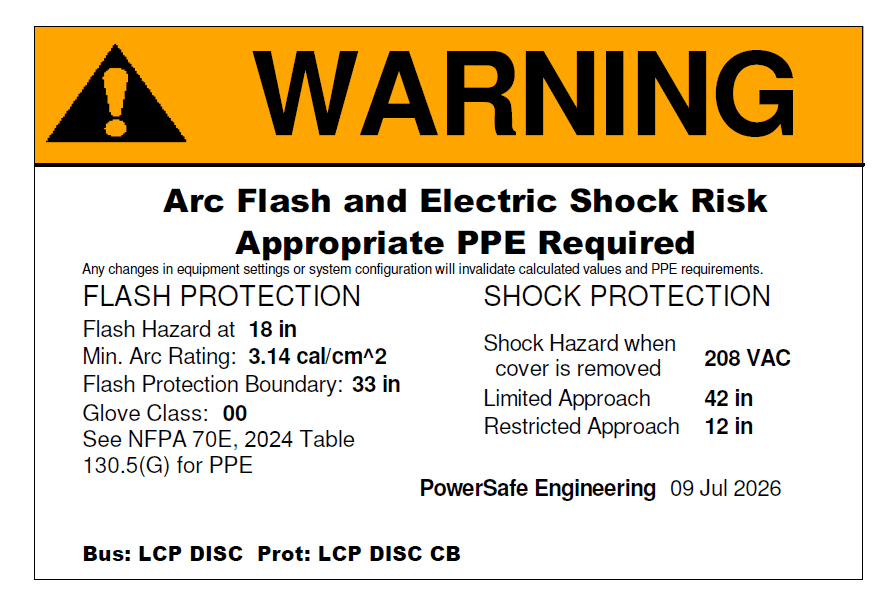
Why it’s required
Requires an arc flash risk assessment before work is performed within the boundary, reviewed at least every five years.
Require hazard assessment and appropriate PPE selection. OSHA points to 70E as the recognized industry practice.
Requires arc flash hazard marking on applicable equipment, with additional label content spelled out for larger service equipment.
A study that predates a service upgrade, a new transformer, or a utility change no longer reflects your available fault current. It will not hold up in an audit, and the labels on the gear are telling your crew something that is no longer true.
Our process
Scoping & fixed-fee proposal
We review your one-line or panel schedules, count devices, and issue a written fixed fee within two business days.
Field data collection
Our engineers document conductors, transformers, device types and existing settings, and confirm utility fault current.
Modeling & analysis
Short circuit, coordination and incident energy analysis in SKM, with mitigation options where energy is high.
PE review & seal
A PE licensed in your state reviews the model and seals the report. Nothing ships unreviewed.
Labeling & handoff
Labels installed on site, findings walked through with your maintenance and EHS teams.
Turnaround & pricing
Expedited schedules are available when a shutdown or an inspection date is driving the work. Use the pricing calculator
Arc Flash Study FAQ
Fee is driven by how many protective devices get modeled, how many services and voltage levels feed them, how many sites are in scope, and how hard the gear is to access. We count devices during a no-cost scoping review, then issue a written fixed fee. No hourly billing.
NFPA 70E 130.5 requires the arc flash risk assessment to be reviewed at least every five years. It also has to be reviewed sooner if a change to the electrical system could affect the results — a new service, a replaced transformer, or a utility upgrade that raises available fault current.
In practice, a qualified engineer working from field-verified data, with the analysis reviewed and sealed by a licensed Professional Engineer. NFPA 70E does not name a credential, but owners, insurers and AHJs generally expect a PE seal, and engineering licensure laws often govern work of this kind.
OSHA cites the PPE and safety-related work practice rules, 1910.132 and 1910.333, and treats NFPA 70E as the recognized industry practice for meeting them. Serious violations carry five-figure penalties per violation, citations can be written per exposed employee, and willful findings run substantially higher.
Incident energy is a calculated value in cal/cm² at a stated working distance. PPE category is a table lookup NFPA 70E permits when incident energy has not been calculated. The two methods are not mixed on the same equipment. A study gives you the calculated number and the minimum arc rating your PPE must meet.
Field data collection runs one to three days for most facilities under about 150 devices. The sealed report follows in two to three weeks. If a shutdown window or an inspection date is driving the schedule, tell us at scoping — field access is usually the constraint, not the modeling.
Yes. We validate it in the field, correct what has changed, and rerun the analysis — typically 20–30% less than a study built from scratch. Very old models, or models missing device settings, sometimes need enough rework that the savings shrink. We tell you which before quoting.
We report the number and hand you options instead of a Danger label: relay setting changes, an arc-energy-reduction or maintenance-mode setting, current-limiting fuses, remote racking, or de-energized-only work rules for that equipment. Sometimes the fix is a setting change that costs nothing. The study should point at the fix.
Yes, if employees or contractors work on the equipment energized. NFPA 70E’s risk-assessment requirement does not have a size threshold. Small facilities are also the fastest and least expensive to study, because the fee scales with protective device count.
Check the study date printed on the label: past five years, or any service upgrade, transformer change, or utility modification since, means the assessment needs review. Labels reflecting outdated fault current give workers the wrong PPE guidance.
Ready to scope your arc flash study?
A 10-minute call with a licensed PE — we'll tell you what your study should cover and what it should cost. No obligation.