
Service
Selective Coordination
Time-current curves and device settings tuned so a downstream fault trips the nearest device and nothing above it.
Last updated:
What is a selective coordination study?
A selective coordination study looks at how your protective devices operate in time and current relative to one another. We plot time-current curves for every breaker, fuse, and relay in a path, then adjust settings so the device closest to a fault clears it first.
When coordination works, a fault on one branch circuit stays on that branch. When it doesn't, the fault walks upstream and drops a main, taking down loads that had nothing to do with it. For emergency systems, legally required standby, and critical operations power systems, the NEC makes coordination a requirement rather than a reliability preference.
What you receive
Time-current curve plots
Coordination plots for every protected path, showing overlaps and miscoordination.
Recommended settings
Relay and breaker settings that coordinate while holding arc flash mitigation in place.
Coordination narrative
Where full coordination isn't achievable and why, with the trade-offs written down.
Native model files
SKM model released to you.
Get this study scoped
Send a one-line or a device count. Fixed-fee proposal in two business days.
Get a Fixed-Fee Proposalor call (571) 310-6945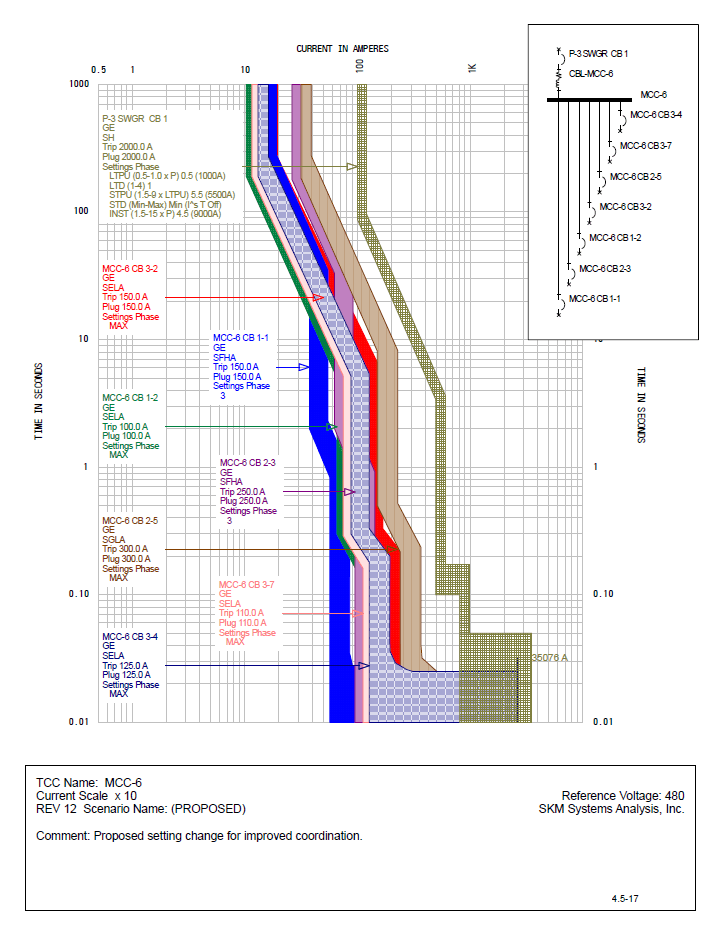
Why it’s required
Overcurrent devices in emergency system supply paths must be selectively coordinated with all supply-side devices.
The same selective coordination requirement applies to legally required standby system overcurrent devices.
COPS overcurrent devices must be selectively coordinated with all supply-side devices.
Coordination and arc flash mitigation pull in opposite directions: faster tripping lowers incident energy but eats coordination margin. We work both on one model instead of optimizing one and letting the other fall where it lands.
Our process
Scoping & fixed-fee proposal
We review your one-line and existing settings and price the study in two business days.
Field data collection
We record device types and as-found settings, and confirm the model against the field.
Coordination analysis
We plot curves, find the miscoordination, and develop settings that resolve it.
PE review & report
A licensed PE reviews and seals the coordination study and the settings recommendations.
Turnaround & pricing
Most efficient alongside your arc flash study, since both run on the same model. Use the pricing calculator
Selective Coordination FAQ
Selective coordination means only the overcurrent device closest to a fault operates. Devices upstream stay closed and their loads stay energized. It is achieved by comparing time-current characteristics along each path and setting or selecting devices so their curves do not overlap in the fault current range.
Emergency systems (Article 700), legally required standby systems (Article 701), and critical operations power systems (Article 708) require overcurrent devices to be selectively coordinated with supply-side devices. Section numbers shift between code cycles, so we cite the edition your AHJ enforces.
Not always. Existing equipment, breaker instantaneous characteristics, and small ratio differences between series devices can make full coordination unachievable without replacing gear. When that happens we document exactly where the overlap is, what it would take to fix, and what the exposure is if you don't.
Often, yes. Nuisance trips frequently trace to instantaneous or short-time pickups set too low for legitimate inrush — motor starting, transformer energizing, or a large UPS. The study identifies those settings and separates them from real faults. Where the cause is a failing device or a ground fault, we say so.
It can. Faster tripping lowers incident energy but reduces coordination margin between devices. The two goals are solved together on one model, and where they genuinely conflict we document the trade-off so you can decide — often with an arc-energy-reduction setting used only during maintenance.
A coordination study is about reliability: which device operates first. An arc flash study is about worker exposure: how much incident energy is released before the fault clears. They share the same model and the same device clearing times, which is why running them together is cheaper than running them apart.
Not usually for microprocessor relays and electronic trip units, which can be reprogrammed with the equipment in service depending on the design. Older electromechanical devices and some breaker trip units need the equipment de-energized. We identify which is which in the report so you can plan the outage.
That is miscoordination: the upstream device is operating before, or at the same time as, the device closest to the fault. A coordination study plots the time-current curves and re-tunes settings so the nearest device clears first and the rest of the plant stays up.
Yes for the essential electrical system. NEC Article 517 and the Article 700/701 emergency-system rules require selective coordination of those overcurrent devices, and accreditation surveys expect documentation of it.
Ready to scope your selective coordination?
A 10-minute call with a licensed PE — we'll tell you what your study should cover and what it should cost. No obligation.